

Key Takeaways
- Corrugated plastic is lightweight, durable, moisture-resistant, and well suited to packaging, signage, and industrial use.
- Clean, dry, well-sorted corrugated plastic scrap is easier to recycle and usually holds more market value.
- Carlin Waste Recycling helps businesses simplify plastic scrap management and recover more value from recyclable materials. Sell your plastic to us!
Corrugated plastic has become a reliable choice for companies that need packaging, protection, or signage that performs better than paper-based alternatives.
In this guide, we’ll cover everything you need to know about this material, including how it’s made, where it’s used, how it compares to other materials, how it’s recycled, and what its scrap value looks like in today’s market.
Let’s get into it!
What Is Corrugated Plastic?
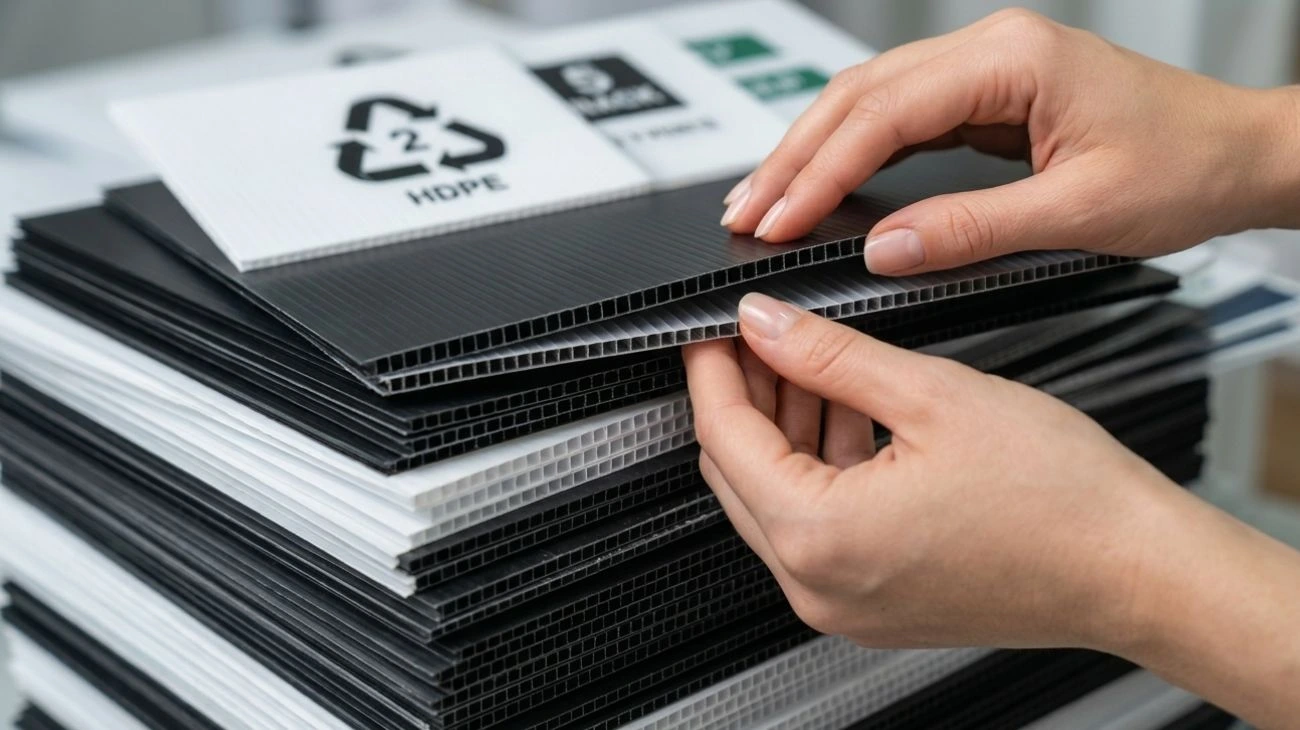
Corrugated plastic is a lightweight fluted plastic sheet, usually made from polypropylene or polyethylene, with internal channels that add rigidity without adding much weight.
This design gives it a high strength-to-weight ratio and makes it a practical choice for packaging, displays, dividers, reusable containers, and other industrial applications.
How Is Corrugated Plastic Made?
Corrugated plastic is made through an extrusion process in which plastic resin is heated, shaped through a die, and formed into a fluted sheet with two flat outer layers.
Once the sheet is formed, it is cooled, cut, and, when required, enhanced with additives or surface treatments for printing, UV protection, anti-static performance, or other industrial requirements.
This process creates a consistent structure while allowing manufacturers to tailor the material for different uses by adjusting thickness, resin type, flute design, color, and surface finish.
What Raw Materials Are Used to Make Corrugated Plastic?
The raw materials used to make corrugated plastic are mainly polypropylene and polyethylene, with the former being one of the most common resins for standard corrugated sheets.
Manufacturers may also add colorants, UV stabilizers, flame-retardant compounds, anti-static agents, or other performance additives depending on how the sheet will be used.
These material choices help producers adapt corrugated plastic to different operating conditions, including outdoor exposure, printed formats, and industrial environments that require extra durability or protection.

What Are the Main Types of Corrugated Plastic?
The main types of corrugated plastic are:
- Polypropylene corrugated plastic: The most common option for packaging, bins, dividers, displays, and general industrial use.
- Polyethylene corrugated plastic: Used when a different balance of toughness, flexibility, or chemical resistance is needed.
- UV-resistant corrugated plastic: Designed for outdoor signs, protective barriers, and other applications with longer sun exposure.
- Specialty industrial grades: Include anti-static, conductive, VCI, laminated, or custom-treated sheets for automotive, electronics, and protective packaging.
What Are the Most Common Applications of Corrugated Plastic?
The most common applications of corrugated plastic are:
- Reusable boxes, bins, totes, and dividers.
- Automotive dunnage and part separators.
- Transit packaging and mail systems.
- Point-of-purchase displays and retail signage.
- Indoor and outdoor signage.
- Shelf bins and warehouse organization.
- Floor and surface protection.
- Agricultural packaging and handling solutions.
- Temporary partitions and barriers.
- Construction and jobsite protection sheets.
Corrugated plastic packaging products are a sustainable alternative to corrugated paper and are recyclable at the end of the product life cycle.
– Primex
What Are the Benefits of Using Corrugated Plastic?
The key benefits of corrugated plastic are:
- Low weight for shipping and handling: Easier to move and store than heavier rigid materials.
- Durability for repeat use: Well suited to returnable packaging, warehouse systems, and reusable storage.
- Moisture and chemical resistance: Performs well in wet, dirty, or wash-down environments.
- Fabrication flexibility: Can be cut, routed, drilled, die cut, folded, welded, and printed for custom applications.
- Longer usable life: Can reduce cost per use when the same packaging system is reused over time.
- Recyclable at end of life: Standard polypropylene corrugated plastic is commonly recyclable as #5 plastic when clean and accepted by the local program or recycler.
Taken together, these benefits make corrugated plastic a practical option for businesses that need a solution that is durable, versatile, and easier to recover at the end of its useful life through reliable recycling services.
How Does Corrugated Plastic Compare to Cardboard and Wood?
Corrugated plastic compares favorably to cardboard and wood. Each option has strengths, but the best choice depends on how the material will be handled, stored, and reused:
| Factor | Corrugated Plastic | Cardboard | Wood |
| Weight | Lightweight | Lightweight | Heavy |
| Durability | Durable enough for repeated use | Best for shorter-term use | Very durable |
| Cost | Moderate upfront cost | Usually the lowest upfront cost | Usually the highest upfront cost |
| Recyclability | Recyclable when clean and accepted locally | Widely recyclable | Recyclable or reusable, depending on condition |
| Moisture Resistance | High | Low | Moderate |
Corrugated plastic sheets provide a lightweight, durable, and cost-effective alternative to traditional materials.
– Coropak
How Is Corrugated Plastic Recycled?
Corrugated plastic is recycled through a multi-step process that transforms used sheets into reusable material for new plastic products. The process typically follows these steps:
Step 1: Collection
Used corrugated plastic sheets, trims, signs, inserts, and packaging components are collected from commercial, industrial, or distribution facilities.
Step 2: Sorting
The material is separated by resin type, color, thickness, and overall condition. Clean, single-resin streams are typically more valuable and easier to process.
Step 3: Contaminant removal
Non-plastic materials such as tape, labels, adhesives, metal fasteners, and dirt are removed. This step is critical for maintaining quality and maximizing recycling value.
Step 4: Size reduction or baling
The material is either compacted into bales for efficient transport or shredded into smaller pieces to prepare it for further processing.
Step 5: Washing and Drying
If needed, the plastic is washed to remove remaining residues and then dried to ensure it is clean and ready for reprocessing.
Step 6: Reprocessing
The clean material is melted and processed into recycled plastic feedstock, often in the form of pellets or regrind, which can be used to manufacture new products.

What Is the Market Value of Corrugated Plastic?
The market value of corrugated plastic scrap is $0.55 per pound in the United States, according to ScrapMonster for #5 PP plastic.
The price varies widely based on factors such as resin type, cleanliness, color, print level, bale quality, volume, and freight costs, so there is no single fixed price.
But clean post-industrial material usually holds more value, while mixed, printed, wet, or contaminated material tends to sell for less due to additional processing requirements.

Maximize the Value of Your Plastic Scrap with Carlin Waste Recycling
If you generate corrugated plastic scrap, at Carlin Waste Recycling we can help you turn that stream into measurable value through a more structured recycling program.
As a recycling broker, we connect recyclable plastic to the right markets while helping you simplify pickups, improve material recovery, and reduce the operational burden of managing multiple vendors.
This approach is especially useful when corrugated plastic is only one part of your waste stream. Instead of treating it as a side issue, you can build a program that improves visibility, supports cleaner sorting, and helps protect the long-term value of your recyclables.
If you want to improve your recycling results, get a quote today!

Corrugated Plastic FAQs
How Long Will Corrugated Plastic Last Outside?
Corrugated plastic can last outdoors for about one year in high-exposure conditions such as Miami for a standard 4 mm white sheet and often longer in milder climates or when UV-stabilized sheets are used.
Is Corrugated Plastic Strong?
Yes, corrugated plastic is strong for its weight because its fluted structure adds stiffness and impact resistance without making it heavy. While it is not a replacement for every rigid structural material, it is strong enough for many packaging, signage, and industrial handling applications.
Can you cut corrugated plastic?
Yes, corrugated plastic can be cut using methods such as routing, sawing, die cutting, drilling, and laser cutting. That flexibility makes it a practical option for custom packaging, partitions, signs, and protective inserts.
Leave a Reply