

Key Takeaways
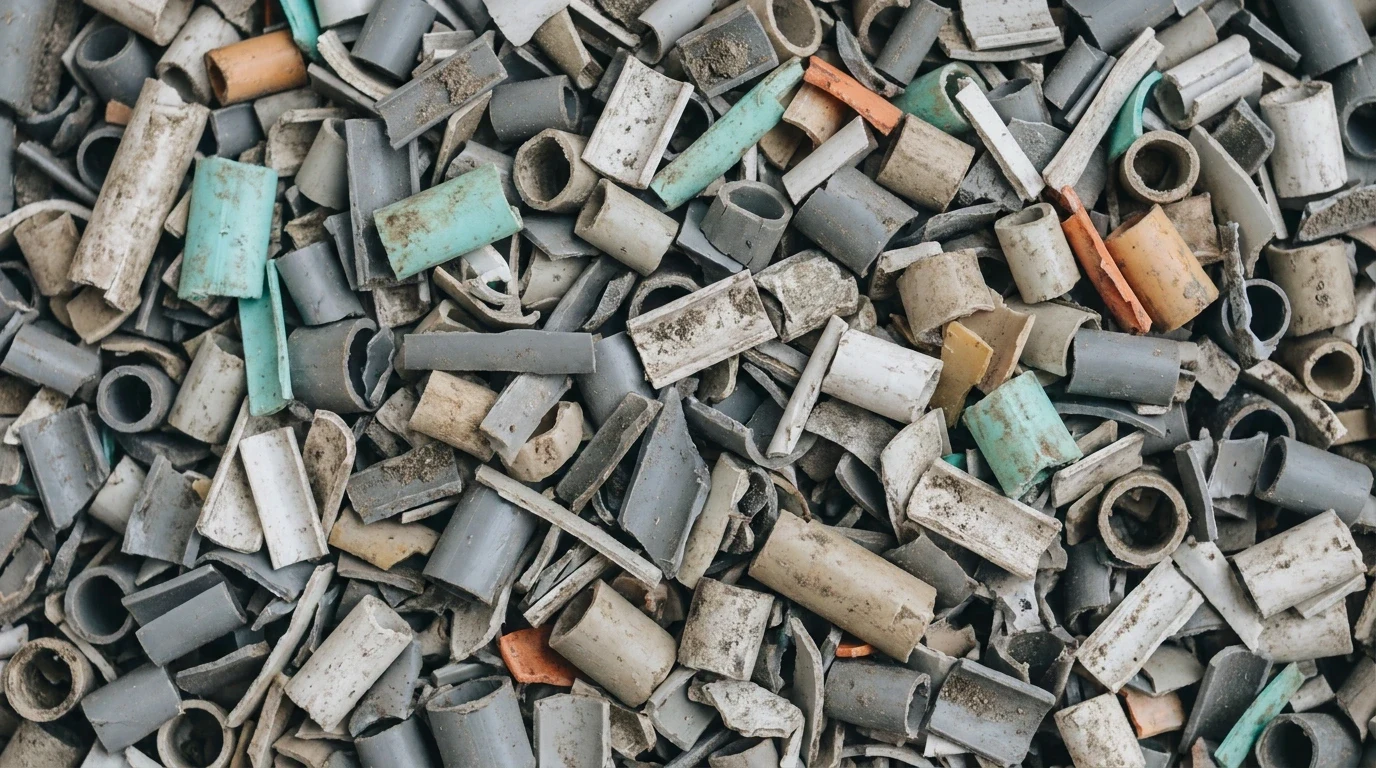
- PVC scrap has strong demand across construction, manufacturing, and plastics recycling industries due to its durability and ability to be reprocessed into new products.
- Clean, sorted PVC scrap from industrial manufacturing can generate competitive market prices, with value depending on material type, color, contamination, and volume.
- At Carlin Waste Recycling, we help businesses maximize the value of their PVC scrap by connecting them with qualified buyers and managing pricing, logistics, and pickup from start to finish. Get a quote today!
If your business generates offcuts, rejected profiles, or other post-industrial PVC scrap, this guide will help you understand how the recycling and selling process works.
Whether you’re a small recycler weighing your options or a manufacturer trying to hit sustainability targets, you’ll find the practical answers you need to work with the right pvc buyers.
What is PVC?
PVC (polyvinyl chloride) is one of the most widely produced plastics in the world, ranking just behind polyethylene and polypropylene in global volume. It’s a synthetic thermoplastic made from vinyl chloride monomers and is valued for its strength, versatility, and low production cost.
Its widespread use generates significant volumes of production scrap and post-industrial material every year.
That steady demand also means there’s an active market for PVC scrap, with recyclers processing the material into feedstock for new products instead of sending it to landfills.
How Is PVC Made?
PVC is made by polymerizing vinyl chloride monomer into a fine resin. Manufacturers typically use one of three main processes: suspension, emulsion, or bulk polymerization, with the choice depending on the intended application.
- Suspension polymerization is the most common pvc recycling process. It creates the porous PVC resin grains used to manufacture products such as pipes, siding, and other rigid building materials.
- Emulsion polymerization creates much finer PVC particles. This type of resin is typically used in specialty applications such as coatings, synthetic leather, adhesives, and vinyl gloves, where a smooth finish or paste-like consistency is required.
- Bulk polymerization is used less frequently but produces very pure PVC resin. Because it involves fewer processing additives, it’s often chosen for applications that require high clarity or specialized material properties.
The resulting resin is then compounded with stabilizers, plasticizers, or other additives depending on whether the final product needs to be rigid or flexible.
What Are the Characteristics of PVC?
The characteristics of PVC are exactly what make it valuable both as a raw material and as a recyclable scrap stream. These include:
- High density.
- Chemical resistance.
- Durability.
- Flame resistance.
- Rigid or flexible formulations.
What Are The Different Types of PVC?
The different types of PVC are classified by their formulation and intended use. The main ones are:
- Rigid PVC (uPVC): used in pipes, fittings, siding, and window profiles; unplasticized and hard.
- Flexible PVC: softened with plasticizers, found in wire jacketing, hoses, and flooring.
- PVC sheet and profile scrap: offcuts from fabrication and extrusion processes.
- Post-consumer PVC: reclaimed from demolition, older pipe, or discarded products.
- Post-industrial PVC: clean manufacturing scrap generated directly on the production line, generally the category pvc buyers pay the most for.
If your business specifically generates sheet offcuts, we cover that material in more depth in our PVC sheet recycling guide.
How Does PVC Compare to Other Resins?
Compared to other resins, PVC offers a distinct combination of durability, chemical resistance, and low cost, though it trails materials like PET and HDPE in recycling infrastructure and scrap liquidity.
| Property | PVC | PET | HDPE | PP |
| Density | High (~1.4) | Medium (~1.38) | Low (~0.95) | Low (~0.90) |
| Chemical resistance | Excellent | Good | Excellent | Good |
| Typical scrap liquidity | Moderate | High | High | Moderate |
| Recycling infrastructure | Limited | Extensive | Extensive | Moderate |
| Common recycled use | Pipe, decking, flooring | Bottles, fiber | Containers, pipe | Auto parts, packaging |
PVC’s chlorine content means it needs to be processed separately from other plastics, which limits how widely it’s accepted compared to PET or HDPE. That’s exactly why working with a PVC scrap broker who understands the material and has dedicated buyers matters more for PVC than for almost any other resin.

What Are the Main Industrial Uses of PVC?
The main industrial uses of PVC span construction, infrastructure, and manufacturing. Some of the most common applications include:
- Plumbing and drainage pipe.
- Electrical conduit and wire insulation.
- Vinyl siding and window profiles.
- Flooring for commercial and healthcare spaces.
- Medical tubing and blood bags.
- Signage and packaging film.
- Automotive interior components.
PVC has long been valued for its durability, versatility, and cost-effectiveness.
– Kevin Koonce, Vinyl Institute
What Are the Advantages of Using PVC?
The advantages of using PVC are that it offers a long service life, performs well in demanding applications, and can be manufactured for both rigid and flexible uses. Its relatively low production cost also makes it practical for large-scale construction and manufacturing applications.
What Are the Disadvantages of PVC?
The disadvantages of using PVC are mostly tied to processing and end-of-life handling:
- Emits hydrogen chloride gas when burned or overheated.
- Requires separate recycling streams due to its chlorine content.
- Can become brittle over time when exposed to UV without stabilizers.
- Historically lower recycling rates compared to PET or HDPE.
Can PVC Be Recycled?
Yes, PVC can be recycled, and mechanical recycling is the most common method used across the United States. Clean, sorted PVC scrap can be reprocessed into pellets or regrind and used again in pipe, flooring, or profile manufacturing, extending the material’s useful life well beyond its first application.
Vinyl can be recycled up to eight times without losing its durability and resilience.
– Ned Monroe, President & CEO, Vinyl Institute
How Is PVC Recycled?
PVC is recycled through a mechanical pvc recovery process that generally follows these steps:
- Collection and sorting: scrap is gathered and separated from other resins, since even small amounts of contamination can affect resale quality.
- Size reduction: material is shredded or granulated into smaller, uniform pieces.
- Washing: the shredded PVC is cleaned to remove dirt, labels, and residual contaminants.
- Drying: moisture is removed to prepare the material for reprocessing.
- Reprocessing: the clean, dry PVC is extruded or pelletized into regrind or resin ready for resale.
- Quality testing: buyers test for purity and consistency before the material is sold into new manufacturing.

Why Is PVC Scrap Valuable to Recycling Buyers?
What makes PVC scrap valuable to recycling buyers is that it offers a lower-cost alternative to virgin resin without sacrificing much in performance.
Manufacturers who use recycled PVC content can reduce raw material costs while also meeting sustainability and ESG reporting requirements that are increasingly common across the plastics supply chain.
A documented case from the cable and wire industry shows the swing in value: PVC jacket cutoffs once cost $0.03 to $0.05 per pound to dispose of, but sold for around $0.30 per pound once recovered at 95% purity (Anixter, “Capitalizing on PVC Scrap Recycling,” 2013).
What Is the Current Scrap Value of PVC?
The current scrap value of PVC ranges from $0.10 to $0.50 per pound in the United States, depending on the type of material (rigid vs. flexible), how clean it is, and the volume being offered, based on recent buy/sell listings on Recycler’s World’s Vinyl Recycling Exchange.
Selling PVC Scrap: What Businesses Should Know
Businesses can sell PVC scrap by working with a recycling broker who evaluates the material, provides a quote, and coordinates pickup and logistics from start to finish.
If you’re wondering where to sell PVC scrap, the process generally starts the same way: you describe the type of PVC, its quantity, and its condition, and a PVC recycling partner responds with a market-based offer, usually within the same business day.

How to Prepare PVC Scrap for Sale
To prepare PVC for sale, a few simple steps can significantly increase what buyers are willing to pay:
- Sort by type: separate rigid PVC from flexible PVC, and keep both away from other resins whenever possible.
- Remove contaminants: strip out metal fittings, tape, labels, and any non-PVC hardware before the material is weighed.
- Consolidate volume: buyers generally offer better per-pound rates for larger, consistent loads than for small, scattered batches.
- Keep it dry: moisture adds unnecessary weight and can affect processing quality.
- Document your material: take photos and note approximate weight or volume before requesting a quote, since this speeds up the evaluation process.

Need a Reliable PVC Recycling Partner? Contact Carlin Waste Recycling
At Carlin Waste Recycling, we have more than 10 years of experience connecting businesses generating PVC scrap with competitive, market-based buyers across the eastern United States.
Whether you’re a small commercial recycler juggling multiple counterparts or a manufacturer trying to simplify your waste program, we handle the sorting logic, the pricing, and the logistics so you don’t have to.
Get a quote today and see what your PVC scrap could be worth.

PVC FAQs
Is PVC Plastic Eco Friendly?
No, PVC plastic is not eco-friendly compared to PET or HDPE, mainly because it releases hydrogen chloride when burned and requires separate handling in recycling streams. That said, PVC is fully recyclable when properly sorted, and diverting it from landfill through a recycling program significantly reduces its environmental footprint.
What Is the Minimum Quantity to Sell PVC Scrap for Recycling?
The minimum quantity to sell PVC scrap for recycling is 20,000 lbs per load, consistent with Carlin Waste Recycling’s standard minimum across other recyclable materials.
Can You Mix PVC With Other Plastics for Recycling?
No, you can’t mix PVC with other plastics for recycling, since even small amounts of PVC contamination can ruin an entire batch of PET or other resins during reprocessing. Keeping PVC separated from the start protects both its own resale value and the value of any other plastics your business recycles.
Leave a Reply