

Key Takeaways
- Clean, sorted, and well-documented TPE scrap is easier to quote because buyers can evaluate grade, color, form, and contamination faster.
- In the United States, TPE can be sold for $0.30 to $0.80 per pound for clean post-industrial material, while higher-value sub-types such as TPU can reach $0.50 to $1.20.
- Carlin Waste Recycling helps businesses prepare, market, and sell plastic scrap through reliable buyer matching and clear pricing support. Get a quote for your TPE today!
If your business generates TPE scrap from parts, purges, trims, regrind, or off-spec production, that excess material may still hold resale value instead of taking up space in your facility.
This guide walks you through everything that affects the resale price of TPE scrap: what makes a stream attractive to buyers, how current U.S. market pricing is trending, how to prepare and document your material, and how to move it through the right recycling channel.
Let’s start!
What is TPE?
TPE is a thermoplastic elastomer, a group of compounds that offers rubber-like flexibility while still behaving like plastic during manufacturing. It can be heated, shaped, cooled, and reprocessed, which makes it practical for high-volume production and recyclable post-industrial streams.
This category includes several families, such as TPS, TPO, TPV, TPU, thermoplastic copolyesters, and thermoplastic polyamides.
Is TPE a Safe Material?
Yes, TPE is a safe material for many applications when it is properly formulated, tested, and used for its intended purpose. You can find it in medical tubing, toys, cable sheathing, beverage closures, consumer goods, grips, seals, and other flexible components.
For scrap sellers, safety also depends on the stream’s history. Colorants, oils, fillers, flame retardants, adhesives, or chemical exposure can affect resale options.
📌 Before sending details to buyers, gather any SDS sheets, supplier labels, technical specs, or production records you have.
How Does TPE Compare to Other Elastomeric Materials?
Compared to other elastomeric materials, TPE offers a practical mix of flexibility, processability, recyclability, and design freedom. It may not replace rubber or silicone in every application, but it can be easier to mold, color, reprocess, and reuse in many production settings.
| Material | Processing | Flexibility | Recyclability | Heat Resistance | Common Uses |
| TPE | Molded or extruded like plastic | High, depending on grade | Often recyclable in clean streams | Moderate to high, depending on compound | Grips, seals, tubing, automotive parts, consumer goods |
| Natural Rubber | Requires curing or vulcanization | Very high | More limited than thermoplastics | Good, depending on compound | Tires, belts, gaskets, vibration control |
| Silicone | Thermoset processing | High | More limited than thermoplastics | Very high | Medical parts, seals, high-heat components |
| TPU | Molded or extruded like plastic | High, with strong abrasion resistance | Recyclable when clean and identified | Good | Footwear, hoses, wheels, films, industrial parts |
| PVC Elastomers | Molded or extruded like plastic | Moderate to high | Depends on formulation | Moderate | Flexible profiles, hoses, cable jackets |
What Are the Main Industrial Uses of TPE?
The main industrial uses of TPE are:
- Automotive seals, trim, mats, interior parts, and airbag covers.
- Tool grips, handles, knobs, and soft-touch surfaces.
- Medical tubing, stoppers, dental products, and healthcare components.
- Footwear soles, cushioning parts, and sports goods.
- Cable jackets, plugs, connectors, and protective covers.
- Flexible packaging components and sealing parts.
- Construction profiles, roofing components, and weather-resistant parts.
- Appliance gaskets, bumpers, and vibration-dampening components.
What Are the Advantages of Using TPE?
The advantages of using TPE include:
- Rubber-like performance. It can bend, stretch, compress, and return toward its original shape.
- Thermoplastic processing. It can be molded, extruded, colored, and shaped using standard plastics equipment.
- Recycling potential. Clean production waste can often be reground or reprocessed.
- Design versatility. Grades can be made in different hardness levels, colors, textures, and finishes.
- Overmolding options. Some compounds bond well to rigid plastics for two-material parts.
- Efficient production cycles. High-volume manufacturing is often simpler than with some cured rubbers.
What Are the Disadvantages of TPE?
The disadvantages of using TPE are:
- Heat limitations. Some grades can soften or lose performance at elevated temperatures.
- Higher cost than commodity plastics. TPE can cost more than basic resins such as PP or PE.
- Creep under load. Certain compounds may deform under long-term stress.
- Formulation variability. Different families and grades can behave very differently.
- Sorting difficulty. Mixed flexible scrap can be harder to identify and resell.
- Additive concerns. Fillers, oils, flame retardants, and coatings may limit reuse options.
📌 From a resale perspective, the biggest challenge is uncertainty. If buyers cannot confirm the grade, chemistry, or contamination level, they may lower the offer or decide the load is too risky to purchase.

Is TPE Recyclable?
Yes, TPE is recyclable when the stream is clean, properly identified, and compatible with a buyer’s processing requirements. Because it’s thermoplastic, it can soften with heat and be reshaped, which gives it better recovery potential than many cured rubber materials.
Industry sources such as HEXPOL and Avient point to this same advantage: thermoplastic elastomers combine rubber-like performance with the processing and recyclability benefits of plastics.
Parts made of TPE can also be recycled at the end of the product’s life cycle.
– Teknor Apex
How Is TPE Recycled?
TPE is recycled through sorting, cleaning, size reduction, testing, and reprocessing into usable feedstock. The exact method depends on the elastomer family, grade, form, and contamination level.
A typical recycling process includes:
- Material identification. The resin family, grade, hardness, color, and source are reviewed.
- Sorting. The stream is separated from rubber, silicone, PVC, metal, paper, cardboard, and mixed plastics.
- Contaminant removal. Labels, dirt, coatings, inserts, and incompatible materials are removed when possible.
- Size reduction. Scrap is ground, shredded, or granulated into a more consistent form.
- Testing. Buyers may check hardness, melt behavior, ash content, color, and contamination.
- Reprocessing. The recovered material may be pelletized, compounded, blended, or used as regrind.
- Resale. The final output is matched with manufacturers or processors that can use that grade.
What Makes TPE Material Scrap Valuable to Buyers?
What makes TPE material scrap valuable to buyers is that clean, identified elastomeric waste can be reused in applications that still need flexibility, softness, impact resistance, or sealing performance. The easier it is to test, process, and place in a resale channel, the stronger the buying interest will usually be.
The strongest value drivers are:
- Known material family. TPU, TPV, TPO, TPS, or another identifiable compound.
- Clean post-industrial source/ Production waste is usually more predictable than mixed post-consumer streams.
- Consistent color/ Natural, clear, or single-color loads are often easier to reuse.
- Low contamination. Less rubber, silicone, PVC, metal, dust, oil, labels, or cardboard.
- Usable form. Regrind, pellets, purges, parts, trims, or sorted components.
- Reliable volume. Recurring loads are more attractive than small, one-time batches.
- Documentation. SDS sheets, supplier specs, photos, lot details, and sample availability can speed up quoting.
Multiple heating and cooling cycles can be repeated, allowing reprocessing and recycling.
– PlasticsEurope
What Is the Current Scrap Value of TPE?
The scrap value of Thermoplastic Elastomer (TPE) in the United States is from $0.30 to $0.80 per pound for clean post-industrial material and regrind, while higher-value sub-types such as TPU (Thermoplastic Polyurethane) can reach $0.50 to $1.20 per pound depending on grade, color, and cleanliness, according to ChemAnalyst.
There is no single public national index for TPE scrap, so quotes are handled case by case. Buyers generally price based on how ready the material is for reuse. Clean, sorted streams from a known source are easier to evaluate and move into resale, while unidentified or mixed lots may require additional review before a value can be confirmed.
Recent market reporting also shows why current quotes matter. ChemAnalyst reported that U.S. TPE prices eased 1.65% week over week in mid-April 2026 after a strong March rally, showing that pricing can shift with demand, logistics, and material availability.

How Can Businesses Sell TPE Scrap?
Businesses can sell TPE scrap by confirming the resin type, separating the stream from other waste, documenting its condition, and requesting pricing from a qualified buyer or recycling broker.
How to Prepare TPE Scrap for Sale
To prepare TPE for sale, keep the stream clean, dry, sorted, labeled, and documented before sending it for review. Buyers need to understand what the material is, where it came from, and whether it can be handled safely.
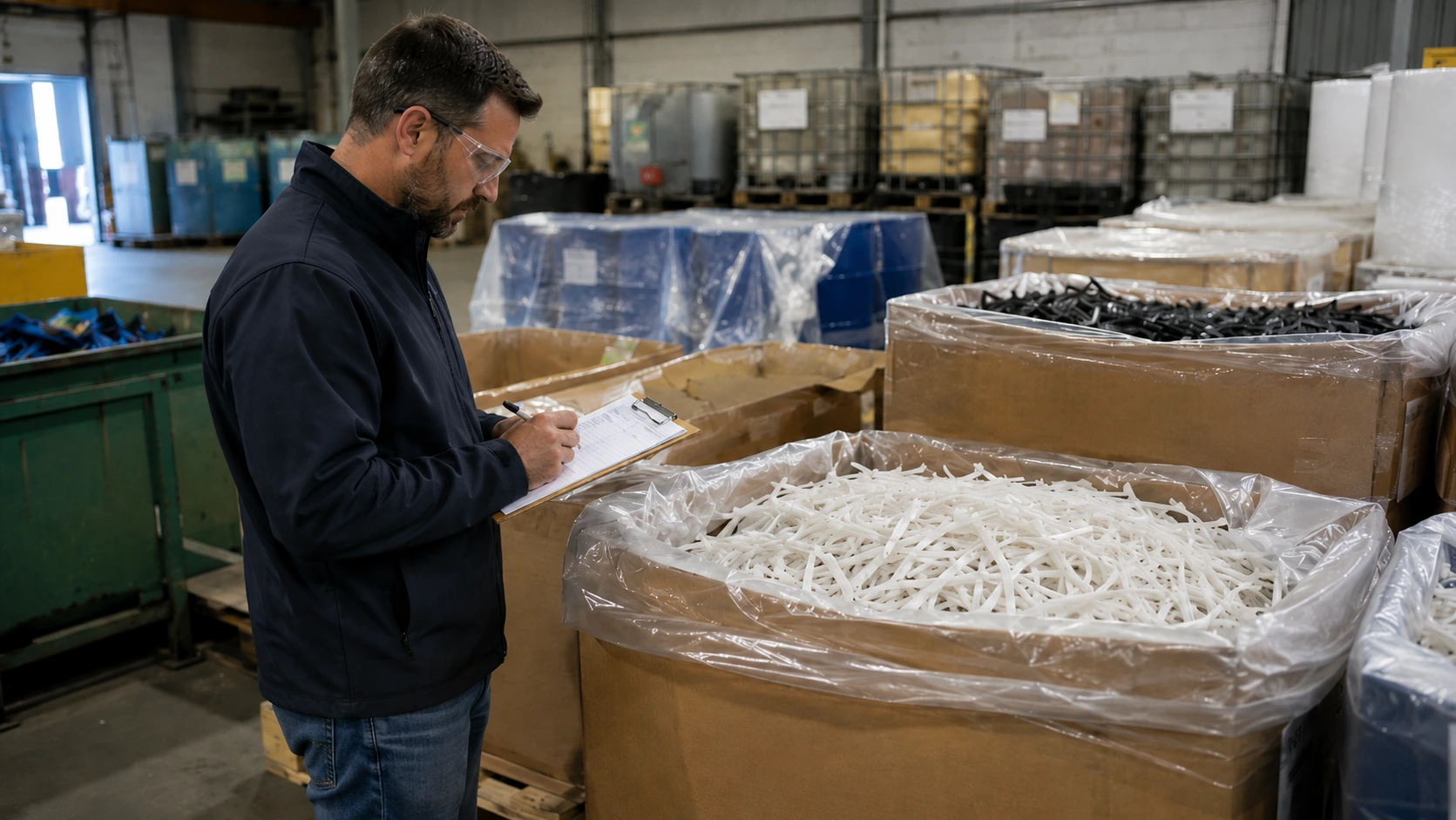
Sort the material by type, color, and production source whenever possible. Keep elastomer families separate; remove contaminants such as metal, labels, cardboard, or mixed plastics; and store loads indoors or under cover to avoid moisture and dirt.
Each container should identify the material type, source, and form, such as purge, regrind, pellets, parts, trims, or off-spec product. If the stream comes from manufacturing waste, it may also fit into a broader fabrication scrap recovery program.

Looking to Sell TPE Material? Carlin Waste Recycling Can Help
If you are looking to sell TPE, we can help you evaluate the stream, understand buyer requirements, and connect it with the right recycling market.
At Carlin Waste Recycling, we support businesses with clean plastic scrap, post-industrial resins, regrind, purges, parts, and trims. We buy, process, and market a wide range of clean plastic scrap, regrind, and post-industrial materials.
Request a Quote to Sell Your TPE Material Scrap Today
If your facility generates clean TPE scrap, regrind, purge, trim, or off-spec parts, request pricing before treating that material as waste. A quote can help you understand potential resale value and available recycling options.
Get a quote today and we’ll help you find a practical path to recover value!

TPE FAQs
How Do I Know What Type of TPE I Have?
You can identify your TPE type by checking supplier labels, SDS sheets, resin documentation, purchase records, part specifications, or lab testing. If the source is unclear, a buyer may request a sample to confirm whether it is TPU, TPV, TPO, TPS, or another elastomer family.
What Is the Minimum Quantity to Sell TPE Scrap for Recycling?
The minimum quantity to sell TPE scrap for recycling is usually 10,000 lbs.
How Long Does It Take to Get Paid for TPE Scrap?
It takes 10 days to get paid for your TPE scrap by Carlin Waste Recycling. Get a quote to sell TPE now!
Leave a Reply